Channel Management
Frequency Channel Saturation
WLAN devices have transmitters and receivers tuned to particular frequencies of radio waves to be able to communicate. One common practice is allocating frequencies as ranges. These ranges are then split once again into smaller ranges called channels.
If there is a high demand for a specific channel, such a channel will easily become oversaturated. This will result in a degraded quality of the overall communication. Multiple techniques to mitigate channel saturation exist and such techniques drastically improve wireless communication since the channels are being utilized more efficiently.
The following are 3 Channel Saturation Techniques
Direct-Sequence Spread Spectrum (DSSS)
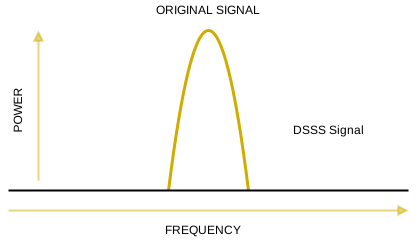
A modulation technique designed to spread radio signal over a wider frequency band. This was primarily used during war periods to make it difficult for enemies to intercept or jam communication singal.
This happens by spreading the signal over a wider frequency which basically hides the peak of the signal. A receiver then will reverse the DSSS Modulation and re-build the original signal. This is mostly used by 802.11b devices to mitigate interference from other devices using the same frequency (2.4GHz)
Frequency-Hopping Spread Spectrum (FHSS)
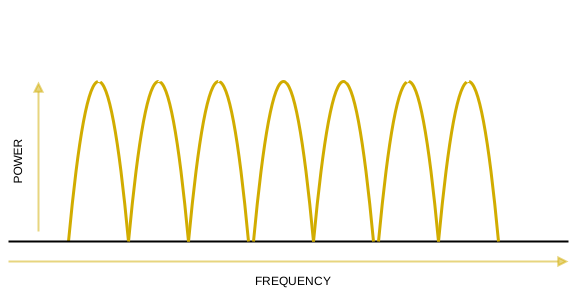
This method transmits radio signals by abruptly switching a carrier signal among many channels. The sender and receiver must both be synchronized to know which channel to jump to.
This channel-hopping process will result in a more efficient usage of the channels, decreasing congestion. This was used by the original 802.11 standard. VHFs and 900MHz cordless-phones also use such a method. Bluetooth also uses a variation of FHSS
Orthogonal Frequency-Division Multiplexing (OFDM)
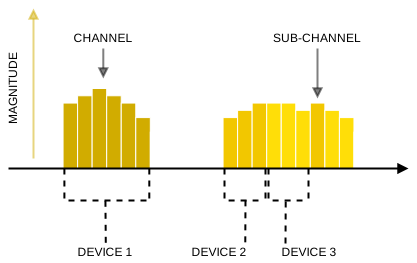
A subset of frequency division multiplexing. In this method, a single channel uses multiple sub-channels on adjacent frequencies.
Sub-Channels in an OFDM system are precisely orthogonal to one another. allowing the sub-channels to overlap without interfering with each other.
OFDM is widely used by a number of communication systems nowadays such as 802.11a/g/n/ac. The new 802.11ax standard uses a variation of OFDM known as OFDMA (Orthogonal Frequency-Division Multiaccess)
Channel Selection
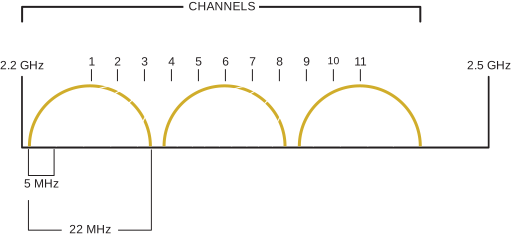
A recommended practice for WLANs which require multiple Access Points is to use non-overlapping channels. Like for example, the 802.11b/g/n standards operate in the 2.4GHz to 2.5GHz spectrum.
The 2.4GHz band is sub-divided into many channels. Each channel is entitled 22MHz bandwidth and is always separated from the next channel by 5MHz.
The 802.11b standard identifies 11 channels in North America, 13 channels in Europe and 14 in Japan.
Interference takes place when a signal overlaps a channel that is reserved for another signal resulting in possible distortion.
[NOTE] Example. If there are 3 adjacent 2.4GHz Access Points, Channels 1,6, and 11 may be used.
5GHz First Eight Non-Interfering Channels
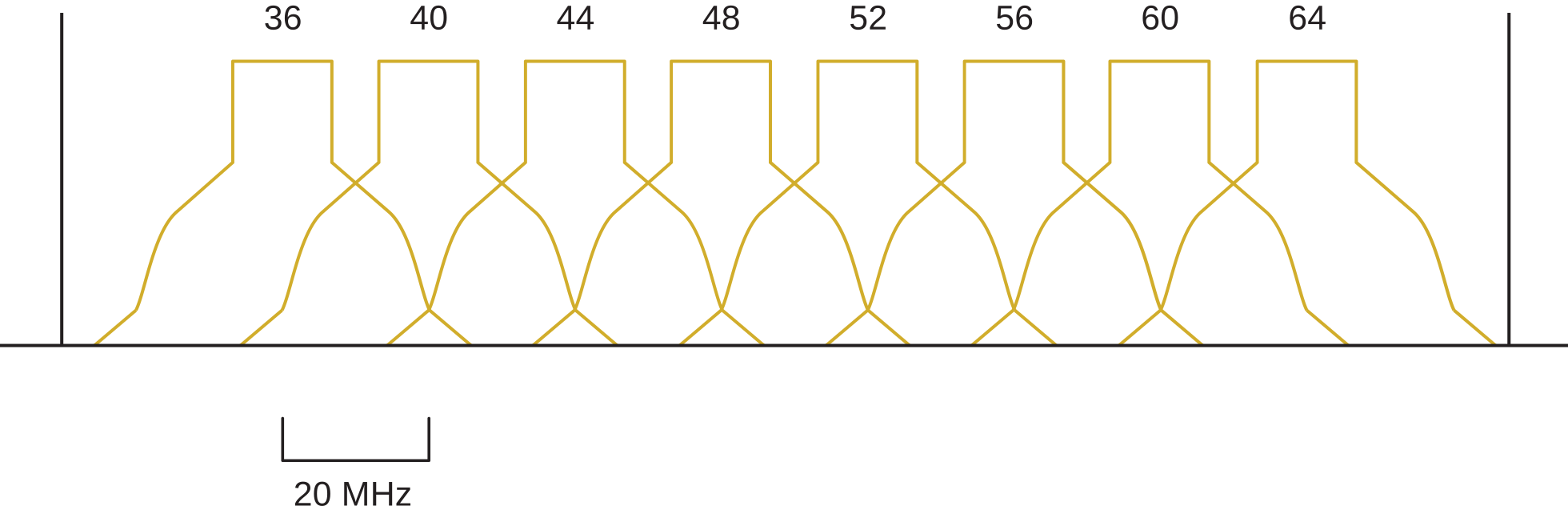
When it comes to the 5GHz standards 802.11a/n/ac, there is a total of 24 channels available.
The 5GHz band is divided into 3 sections. Each channel is separated from the next channel by 20 MHz.
5GHz can provide much faster transmission for wireless clients in heavily populated wireless networks due to a large amount of non-overlapping wireless channels.
[NOTE] Example. If there are 3 adjacent 5GHz Access Points, Channels 36,48, and 60 may be used.