Switch Forwarding Methods
Switches make Layer 2 forwarding decisions very fast. Switches are able to abruptly do such decisions thanks to the software on Application Specific Integrated Circuits (ASICs).
ASICs is there to reduce the frame-handling time within the switch and allow it to manage an increased number of frames without reducing performance.
Presently, 2 different methods of Frame-Switching exist:
| Store and Forward Switching |
| This is the most used method since it also provides error-detection. This method makes forwarding decisions on a frame after it has received the complete frame and has also been checked for errors using a mathematical error-checking mechanism widely known as a Cyclic Redundancy Check (CRC). This is Cisco’s default LAN switching method. |
| Cut-Through Switching |
| The alternate method is what’s know as Cut-Through Switching. This method is usually used where speed really matters most. This method begins to forward a frame immediately after the destination MAC Address of an incoming frame and the egress port has been determined by the switch. |
Store and Forward Switching
This Switching method, has the following two features
| Error Checking |
| After receiving the complete frame on the ingress port, the switch will compare the Frame Check Sequence (FCS) value in the last field of the datagram and compare it against its own FCS result. The FCS is an error-checking process that makes sure that the frame does not have any physical or data-link errors. Once the frame is verified as “error-free”, the switch will forward the frame. If not, the frame will be dropped. |
| Automatic Buffering |
| The Automatic Ingress port buffering process used by the Store and Forward method, will allow any mix of Ethernet speeds; For example, a Frame coming in on a 1Gbps interface that must be forwarded out a 100Mbps interface. If there is a mismatch between the ingress and the egress ports, the switch will store the entire frame in its buffer, verifies the FCS, then forwards it to the egress port buffer and finally sends the frame. |
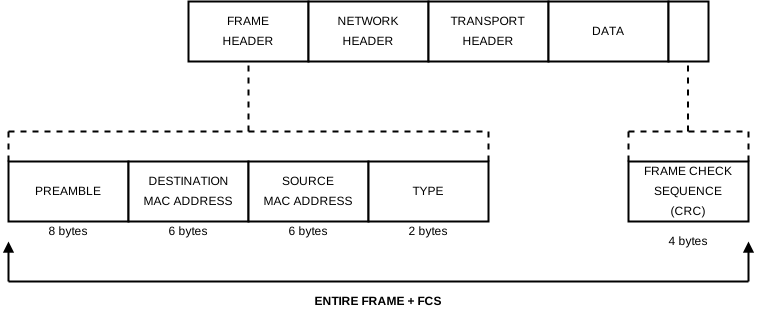
Store and Forward Switching will require a receipt of the entire frame before a forwarding decision is made
Cut-Through Switching
Store and Forward switching will of course drop invalid frames that do not pass the Frame Check Sequence. On the other hand, Cut-Through switching may forward invalid frames since there is no FCS check for the frame to go through.
Cut-Through switching is able to perform rapid frame switching since the switch will start to make forwarding decisions as soon as it has searched and compared the Destination MAC address to the one in the CAM Table.
The switch will not have to wait for the rest of the frame to enter the ingress port before it starts forwarding it.
Cut-Through Switching is split into 2 sub-categories as per below
| Fast Forward Switching |
| This is a method offering the very lowest level of latency. This method will immediately forward a packet after reading just the destination address. Because this method starts forwarding immediately before the whole packet has been received, there may be packet errors. If this happens, the destination NIC will discard the errored packet when received. When using this method, latency will be measured from the first bit received to the first bit transmitted. |
| Fragment Free Switching |
| When using this method, the switch will store the first 64 bytes of the frame before forwarding it. The switch starts forwarding the frame after it has read the Type field. This is well known as a compromise between Store and Forward switching and Fast-Forward switching. The first 64 bytes are stored because usually there is where most network errors and collisions occur. This method also performs a small error check on the first 64 bytes of the frame to ensure that no collisions occurred before forwarding. |
[NOTE] In environments where High-Performance Computing Applications (HPC) that require latencies of 10 microseconds or less are used, this type of switching method is highly popular but bear in mind that frames can be forwarded with errors and if there’s a high error rate within the network, this might have a negative impact on the network’s bandwidth.
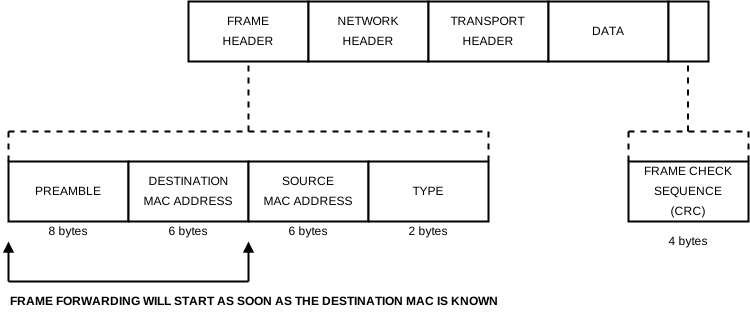
Cut-Through Switching will not require a receipt of the entire frame before it starts to forward frames, therefore, Frame forwarding will start as soon as the destination MAC Address is known