Legacy Inter-VLAN Routing
The Legacy Inter-VLAN routing solution relies totally on a router that has multiple Ethernet interfaces. Each interface will be connected to a switch-port in a different VLAN. The router interfaces will then serve as a default gateway to the local hosts on the VLAN subnet.
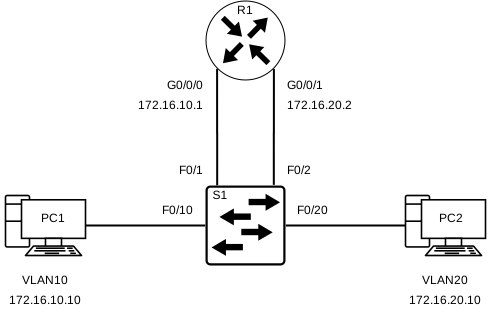
- F0/1 is assigned to VLAN 10 and is connected to R1 via interface G0/0/0 (network 172.16.10.x)
- F0/10 is assigned to VLAN 10 and is connected to PC1
- F0/2 is assigned to VLAN 20 and is connected to R1 via interface G0/0/1 (network 172.16.20.x)
- F0/20 port is assigned to VLAN 20 and is connected to PC2
| Port | MAC Address | VLAN |
|---|---|---|
| F0/1 | R1 G0/0/0 MAC | 10 |
| F0/10 | PC1 MAC | 10 |
| F0/2 | R1 G0/0/1 MAC | 20 |
| F0/20 | PC2 MAC | 20 |
If PC1 sends a packet to PC2 which is theoretically on another network, it will forward the packet to its default gateway which is 172.16.10.1 on R1 G0/0/0.
R1 will then route the packet out G0/0/1 interface to F0/20 port which is in VLAN20 on S1. The switch will forward the frame to PC2
Legacy inter-VLAN routing is not recommended since it uses physical interfaces to operate which portrays a significant limitation. Routers have limited number of physical interfaces therefore requiring a physical interface per VLAN will quickly exhaust the physical interface capacity of a router.
[NOTE] This solution of Inter-VLAN routing is strongly discouraged and no longer implemented in switched networks